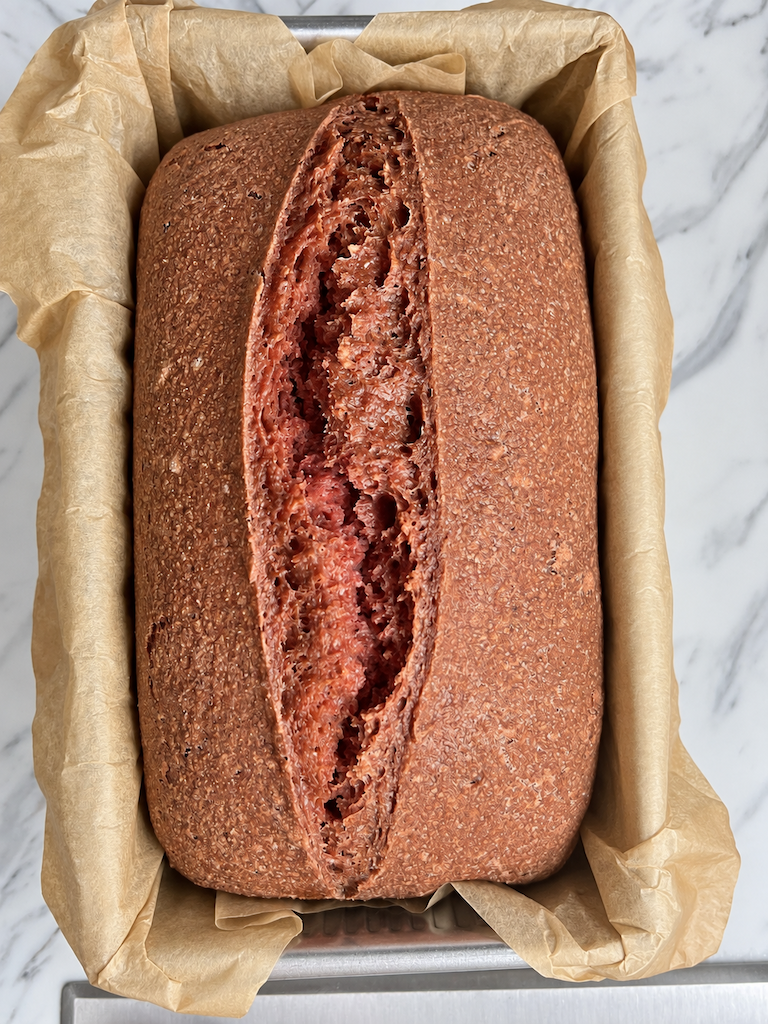
This sourdough beet bread is a fun fall baking project, especially when fresh beets are in season. Made with homemade beet puree, active sourdough starter, fresh-milled hard red wheat, spelt, and khorasan, it has a subtle earthy flavor and a soft texture that pairs so well with hearty stews and meaty dishes.
If you’re like me and you love beets, try using it for a sandwich with plenty of sauerkraut! It is so delicious! I enjoy it simply toasted with butter too.
Making the beet purée adds an extra step, so this is a great recipe to save for a day when you have a little more time on your hands. You can also prepare the purée ahead of time to make your bread-making day faster.
A Hearty Loaf with a Soft, Moist Texture
One of my favorite things about this bread is how wonderful the dough feels. It’s soft and extensible, making the stretch and folds especially satisfying.
The beet purée gives the finished loaf a subtle earthy flavor without making it overwhelmingly beet-forward. It also adds moisture, so expect a moist crumb rather than a dry or crumbly slice. I really enjoy the texture as it is, but toasting helps dry it out a little if that’s your preference.
This is also the kind of hearty bread I love having ready at mealtime. A slice or two alongside a stew or a meaty main dish makes an easy, filling side without having to prepare something extra.

How to Make Sourdough Beet Bread with Fresh-Milled Flour
Prepare the beet purée and mill the grains
Start by making your beet purée and allowing it to cool. Then mill the hard red wheat, spelt, and khorasan for your dough.
Having the purée ready before you begin mixing makes the process much smoother.
Autolyse the flour and water
Mix the fresh-milled flour and beet puree/water combination, then let the mixture rest. This step, called an autolyse, gives the flour time to absorb the water and allows the bran to soften before you continue mixing. I usually autolyse for 1 hour, but between 20 minutes – 3 hours works for this.

Mix the dough
After the autolyse, add the active sourdough starter, and salt. Mix until everything is evenly combined. I like getting my hands in the dough, but feel free to use a mixer if you prefer.


Complete four sets of stretch and folds
Do four sets of stretch and folds, spacing them 20 minutes apart. These folds help strengthen the dough as fermentation gets underway.

Finish bulk fermentation
After the final set of folds, let the dough continue fermenting until it has risen, shows plenty of small bubbles along the sides, and jiggles when you gently shake the bowl.
Watch the dough for these signs rather than relying only on the clock. The temperature of your kitchen and the activity of your starter will affect how quickly it ferments.

Shape and refrigerate
Shape the dough into a loaf and place it in a 9 × 5-inch loaf pan lined with parchment paper.
Place in a 2 gallon zip top bag and refrigerate for 3–16 hours. This gives you some flexibility in deciding when to bake. You don’t want to push this too far with fresh-milled flour as it can become too sour if left more than 16 hours.
Two Baking Methods
Double Loaf Pan (my preferred method for this bread) – Shape the dough and put it in a 9×5 inch loaf pan lined with parchment paper. Refrigerate for 3 hours before baking. After two hours, preheat your oven to 500 degrees F. When it’s time to bake, grab two room temperature 9×5 inch loaf pans. Lift the dough out of the cold pan and place in one of the room temperature pans. Score the loaf and cover with the other room temperature loaf pan. Place in the oven and turn the temperature down to 450 degrees F. Bake for 45 minutes, then remove the top loaf pan and bake for an additional 4-5 minutes.
Dutch Oven or Multi-Cooker – Shape the dough and put it in a 9×5 inch loaf pan lined with parchment paper. Refrigerate for 3 hours before baking. After two hours, put your dutch oven or cast iron multi-cooker in the oven and preheat to 500 degrees F. When it’s time to bake score the loaf and using the parchment paper to lift the dough out of the pan and place it in the hot dutch oven or multi-cooker. Place the lid on and put it in the oven. Turn the temperature down to 450 degrees F and bake for 40 minutes. Remove the lid and bake for an additional 3-4 minutes.
Tips for This Fresh-Milled Sourdough Beet Bread
- Prepare the purée ahead. It makes this recipe easier to fit into your baking routine.
- Give the flour time to hydrate. The autolyse helps soften the bran in the fresh-milled flour.
- Watch the dough during bulk fermentation. Look for a rise, small bubbles around the sides, and a gentle jiggle.
- Expect a moist crumb.The beet purée gives this bread a naturally moist texture.
How to Store and Freeze Sourdough Beet Bread
Once the loaf has cooled completely, store it covered at cool room temperature and plan to enjoy it within a week. If it is very warm and humid in your home, it has the potential to mold faster due to the moisture content from the beet puree.
To Freeze – slice the cooled bread, place on a parchment lined baking sheet and freeze for several hours. Then transfer the slices to a freezer bag to freeze for up to 6 months. Having individual slices ready makes it easy to take out whenever you want a slice.

Sourdough Beet Bread

Equipment
- 1 Kitchen Scale
- 1 Grain Mill optional, can be made with store bought flour
- 3 9×5 inch loaf pans
Ingredients
Beet Puree
- 4 large beets washed, skin on
Make the Bread
- 400 g hard red wheat
- 100 g spelt
- 50 g khorasan
- 275 g beet puree
- 259 g water
- 11 g salt
- 100 g sourdough starter
Instructions
Make the Beet Puree
- Preheat your oven to 450℉
- Place the beets in a parchment lined baking dish and cover with foil.
- Roast the beets for 1 hour or until tender when poked with a fork. Remove from the oven and let cool slightly – just cool enough to handle.
- Peel the skin, then cut the beets into large cubes and place into the bowl of a food processor. Process until smooth. Reserve 275g for the bread and transfer the rest to a container for later use. Store in the fridge for up to one week or freeze for several months.

Make the Bread
- To use fresh-milled flour – weigh your grains and stir to combine. Then mill them on the finest setting of your grain mill.400 g hard red wheat, 100 g spelt, 50 g khorasan

- To a large measuring cup, add the beet puree and water. Whisk to combine.275 g beet puree, 259 g water

- Add the beet puree and water combination to the flour. Use your hand or a dough whisk to combine until no dry flour remains in the bowl and a ball forms. Add additional water if it is still dry after mixing for several minutes. Cover the bowl and let autolyse at room temperature for 1 hour.

- Add the salt and sourdough starter. Combine with your hand until fully incorporated and a smooth ball forms. Cover and let sit at room temperature for 1 hour.11 g salt, 100 g sourdough starter

- Perform the first stretch and fold by lifting the dough up and over itself 4 times around the bowl. Cover and repeat every 20 minutes for a total of 4 stretch and fold sessions.

- After the last stretch and fold, cover the bowl and let sit at room temperature for 2 1/2 – 9 hours. The amount of time depends on the temperature of your house. It takes about 2 1/2 hours when my house is warm. Watch for signs such as many small bubbles around the sides of the dough. It should jiggle when you shake the bowl. An easy hands off approach is to make this in the evening before you go to bed and let it sit at 65℉ for 8-9 hours.

- Once the dough is fully fermented, line a 9×5 inch loaf pan with parchment paper. Then turn the dough out onto a lightly wet surface and pat it into a rectangle. Roll the dough up and into a loaf shape, pinching the seams. Place seam side down in the prepared loaf pan. Place in a 2 gallon zip top bag and place in the refrigerator. Leave in the fridge 3 – 16 hours.

- Once ready to bake, preheat your oven to 500℉ and set a timer for 1 hour.
- Remove the dough from the zip top bag and lift it using the parchment paper and place it into a room temp loaf pan. Score the loaf using a lame or razor blade. Then cover with the third loaf pan.

- Place in the oven and reduce the oven temperature to 450℉. Bake the bread 45 minutes covered and an additional 4-5 minutes uncovered.

- Cool completely on a wire rack.

Notes
- Hard red wheat can be substituted with hard white wheat
- If you don’t have spelt or khorasan, use all hard red wheat
- If you don’t have khorasan, substitute with more spelt



Leave a Comment